
Use case
How to identify automation opportunities from evidence, not workshops
To identify automation opportunities on evidence, start from what each task costs and where each process waits. Opus (task mining) costs every recorded task case from its duration and the department's rate, and Favus (process mining) shows where cases wait between steps.
Why automation candidates are hard to pick
A shortlist drawn up in workshops rests on what people remember about the work, not on what it costs or how often it varies.
Picks that reflect memory
Candidates put forward in a workshop reflect what participants recall and agree on, not recorded time and cost.
No cost for each task
Without a cost for each task and for each way of doing it, the costliest work is hard to spot and harder to compare.
Variation stays hidden
When the same task is done several ways, a design built around one way can miss the rest.
How do you identify automation opportunities with Optimus Hive?
Record and cost the work, find where cases wait, list the costliest work, then measure each candidate before anyone designs a change.
Record and cost the tasks
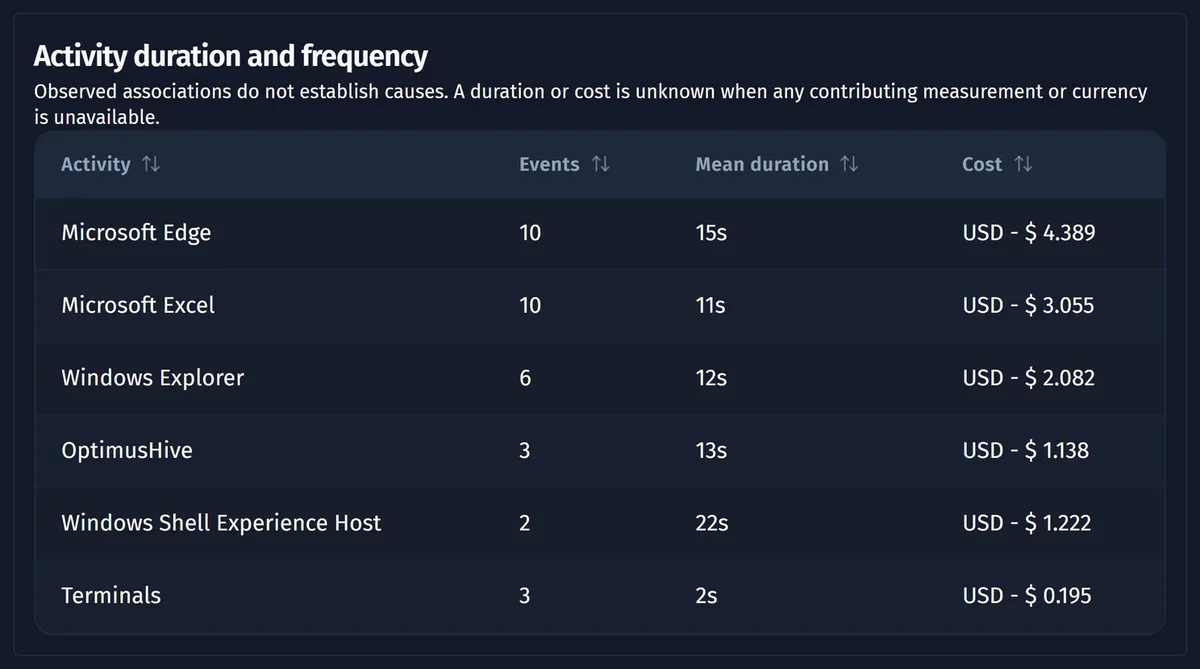
Employees record their tasks in Opus on their Windows desktops. Opus costs each recorded case as its duration times the department's hourly or daily rate. The task process map shows each variant's average case cost, so expensive variants stand out.
Find where cases wait
Favus maps the end-to-end process from your business systems' event logs and shows where cases wait between steps. Favus also breaks slow cases down by vendor, customer type or resource, and shows how much of each activity already runs without people today.
List the costliest work
Your team brings the findings into Via (transformation planning), which lists your costliest tasks and processes and the pain points that have no change request yet.
Measure a candidate before any design
Agent Studio in Opus measures a chosen task first: its recorded cases, the source events behind them and the most common application path.
Let Opus find and rank repeated work
Opus also looks for work patterns that repeat across people and days, for reviewers to accept or reject. Opus then ranks candidates by measured volume, stability and exceptions, against the cost assumptions you enter.
What you get: costed candidates for automation
You get a view of which tasks and process steps take the most time and money, built from recorded work rather than workshop notes.
Cost per task case and variant
Recorded time and cost for every task case, in the department's currency, with the average cost of each variant.
The longest waits in the process
The transitions where cases wait longest, from the performance view of the Favus process map.
Segments that go with slow cases
Which vendors, customer types or resources go with the slowest cases, as a breakdown to investigate rather than a proven cause.
Exceptions with an owner
Exceptions that employees log during a task, turned into investigations with an owner and a history of actions.
Questions about identifying automation opportunities
Buyers ask these questions about finding automation candidates with Optimus Hive.
Does Optimus Hive decide what to automate?
No: Optimus Hive measures and costs the candidates, and your team decides what to automate or hand to AI agents. Opus shows what each task and variant costs, and Favus shows where cases wait. Via lists your costliest tasks and processes, but it does not score or choose them for you.
What makes a task a good candidate for automation?
A good candidate is usually frequent, done the same way most of the time, costly and light on exceptions. Opus gives you evidence for each: how often the task is recorded, how many variants it has, what each case costs and which exceptions employees log. Your team weighs that evidence against the effort of the change.
Do we need process mining to find automation opportunities?
No, you can start with Opus alone, but Favus adds what happens between the desks. Opus shows what tasks cost at the desktop. Favus shows where whole cases wait inside your business systems, which desktop data cannot see.
Can Opus find automation candidates on its own?
Yes, within limits you set: Opus looks for work patterns that repeat across people and days, over up to 90 days and up to 100 applications. Reviewers accept or reject each pattern, and Opus can rank candidates by measured volume, stability and exceptions against your cost assumptions. The decision stays with your team.
Find your automation candidates in a demo
Request a demo and bring one process you would like to automate. We'll show how Opus and Favus measure it, and where its time and cost go.