
Blog
Task case review: what analysts check step by step
A practical guide for operations and automation leaders on what analysts check when they review a recorded task step by step.
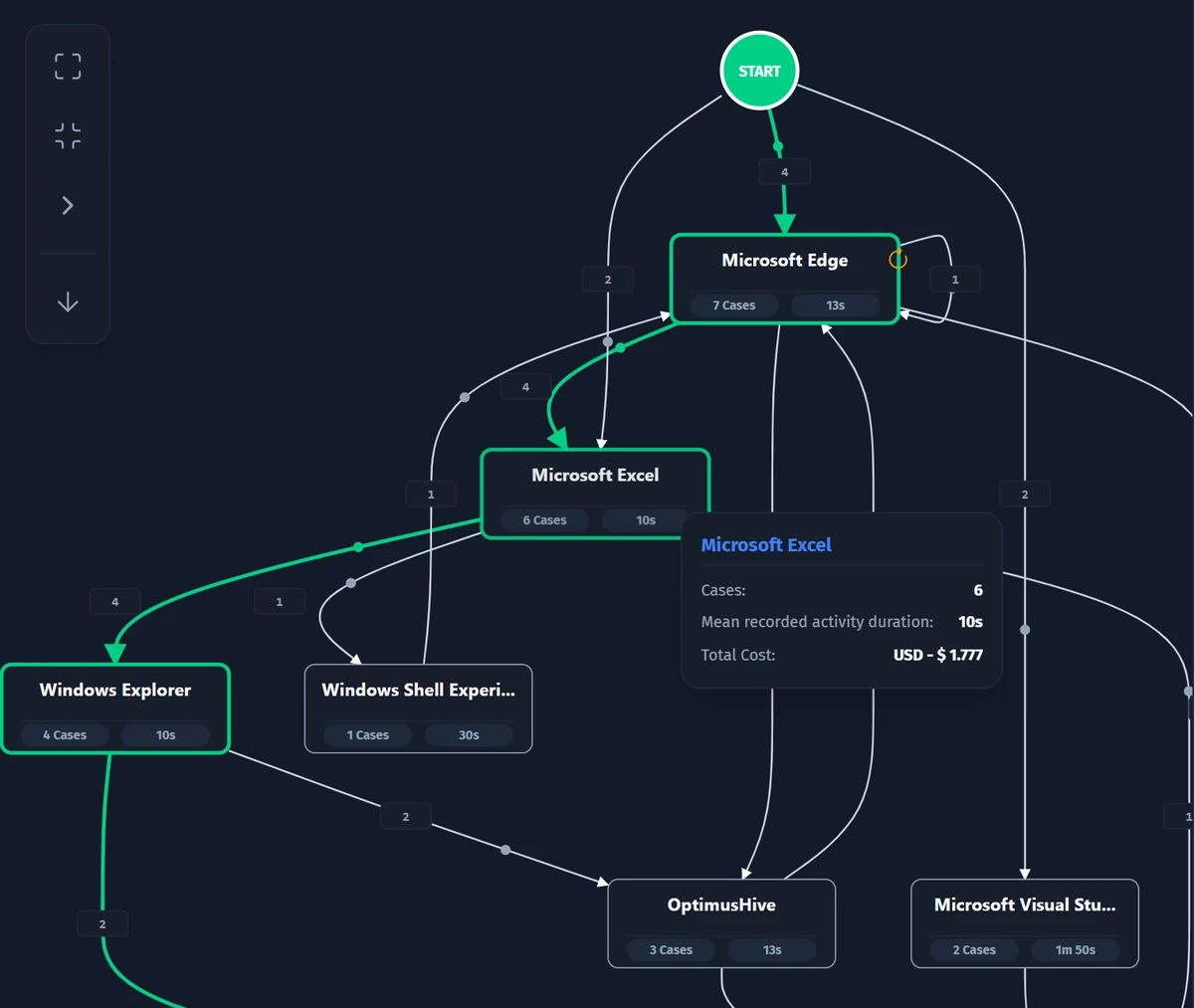
A task case review is a step-by-step check of one recorded run of a task. Analysts confirm where the task starts and ends, study how long each step takes, flag waits, loops and workarounds, compare runs, and note what the team should standardize before anyone documents, redesigns or automates the work.
- A task case review checks one recorded run of a task, step by step, before anyone draws conclusions.
- Correct task boundaries come first, because wrong start and end points distort every later number.
- Waits, loops, application switching, manual re-entry and workarounds are the steps that deserve a closer look.
- Comparing several runs of the same task separates habit from necessity and reveals a clean reference run.
- People decide what to do with review findings; the review gives them an accurate picture of the work.
What is a task case review?
A task case review is a step-by-step check of one recorded run of a task, called a case. Analysts read the case in order to understand what the work really involves.
Task mining records how people complete work on their desktops. The output is a set of cases, each made of steps with times and durations.
A task case review matters because recordings are raw material. Without review, teams risk building plans on cases that are mislabeled, incomplete or untypical.
Who should take part in a task case review?
A task case review works best when an analyst and someone who does the work read the case together. The analyst brings method; the practitioner explains why each step happens.
Practitioners often know the reasons behind odd steps, such as a system that needs a second save or a check a manager expects. Analysts alone may misread those steps as waste.
A short, focused session per task usually beats a long workshop. Your team keeps attention on the case in front of them.
Are the task boundaries right?
The first thing analysts check in a task case review is whether the case starts and ends in the right place. Wrong boundaries distort every later number.
- Start point: does the case begin with the actual trigger, such as opening a request, rather than an earlier unrelated action?
- End point: does the case close when the work is done, or does it run into the next task?
- Scope: does one case hold two tasks that should be separate, or is one task cut across two cases?
- Label: does the task name match what the person actually did?
Teams often find boundary problems in the first cases they open. Fixing task boundaries early keeps durations and counts meaningful.
Which steps deserve a closer look?
Within a case, a task case review focuses on steps that consume time without moving the work forward. Step durations point analysts to these steps quickly.
- Waiting steps, where the person pauses for a system, a reply or an approval.
- Loops, where the same step repeats because data was wrong or missing.
- Application switching, where the person moves between tools to find or copy information.
- Manual re-entry, where the same data is typed into more than one system.
- Workarounds, such as side spreadsheets or personal notes that the official process does not mention.
Each of these patterns is a candidate for improvement. Analysts record what they see in a short comment, so the observation is not lost.
How do analysts compare runs of the same task?
A single case shows one way of working; a task case review becomes useful when analysts compare several runs of the same task. Comparison separates habit from necessity.
Analysts look at why some runs are short and others long. The cause may be the type of request, the experience of the person or a missing input.
Analysts also look for the cleanest run: the one that reaches the right result with the fewest detours. Teams often treat that run as the reference for training and redesign.
Exceptions deserve their own note. A long run is not always a bad run; some cases are genuinely harder and need a separate path.
How does Opus support a task case review?
In Opus task mining software, each recorded case expands into its steps, with the time and duration of each step. Analysts can add comments.
In Opus, analysts can split, merge or reassign task boundaries.
In Opus, analysts can mark the best recorded run as the approved way of working.
What happens after a task case review?
A task case review ends with findings that people act on: corrected task boundaries, annotated steps and a shortlist of issues. Your team decides which findings to pursue.
Reviewed cases are a strong base for as-is process documentation, because the steps reflect how work is actually done rather than how a manual describes the work.
Reviewed cases also help you judge which work suits AI agents. Stable, rule-based steps with clear inputs are usually better candidates than steps full of judgment calls and exceptions.
Finally, a task case review sets expectations. When leaders see the actual steps, they plan from the work as it is, not as it was assumed to be.
Checked automatically against Optimus Hive product documentation before publication.