
Blog
Process variants explained: why the same process runs many ways
Learn what process variants are, why the same process runs many ways, and how operations and transformation leaders decide which variants to keep.
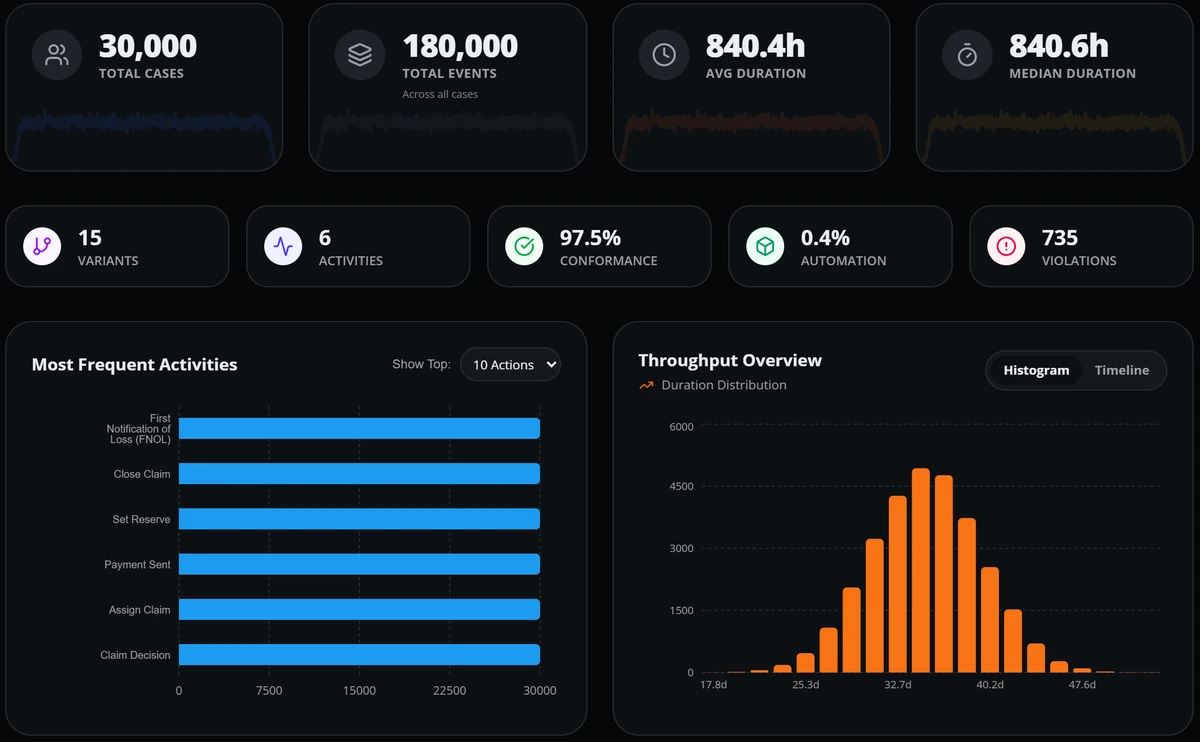
Process variants are the different paths that cases take through the same process. They appear because exceptions, rework, business rules, system workarounds and personal habits push cases off the intended path. Ranking variants by frequency, coverage, duration and cost shows which ones to standardize, keep as justified branches or remove before automation.
- A process variant is a distinct sequence of activities that a case follows from start to finish.
- Exceptions, rework, business rules, system limits and personal habits create most process variants.
- A few variants usually cover most cases, followed by a long tail of rare paths.
- Teams rank variants by case count, coverage, duration and cost, then ask why each variant exists.
- Standardizing the main paths comes before handing work to AI agents.
What are process variants?
A process variant is a distinct sequence of activities that a case follows from start to finish. Process variants are the different paths that real cases take through the same process.
A case is the unit of work that moves through the process, such as an invoice, an order or a service request. Activities are the steps recorded along the way, such as receive, check, approve and pay.
When cases follow the exact same order of activities, they share a variant. When a step is added, skipped, repeated or reordered, the case belongs to a different variant.
The documented process usually describes the intended path, often called the happy path. Process variants show what happens in practice, including every detour from that intended path.
Process mining is the usual way to find process variants at scale. Process mining reconstructs case paths from the event logs that business systems record.
Why does the same process run in many ways?
The same process runs in many ways because real work meets conditions that the process design did not anticipate. Process variants usually come from a handful of recurring causes.
- Exceptions: missing data, mismatched amounts or unusual requests send cases into extra checks.
- Rework: errors found late force steps to repeat, which creates loops in the path.
- Business rules: different thresholds, products, customer types or regions require different approvals.
- Systems: workarounds, manual re-entry between applications and system limits add steps.
- People and habits: teams and individuals develop their own order of work, often for good reasons.
- Organizational change: mergers, reorganizations and new tools leave old and new paths running side by side.
Some process variants are intentional and valuable. A high-value order may rightly need an extra approval step.
Other process variants are waste that nobody chose. These variants grow quietly as small workarounds become habits and habits become the normal way of working.
Which process variants matter most?
The process variants that matter most carry many cases, take much longer or cost much more than the main path. Teams usually rank process variants by frequency, coverage, duration and cost.
Most processes show a familiar pattern. A few variants cover a large share of cases, and a long tail of rare variants covers the rest.
Measures teams use to rank process variants
- Case count: how many cases follow the variant.
- Coverage: the share of all cases that the variant represents.
- Average duration: how long a case on that path takes from start to end.
- Cost: the effort and handling cost that a case on that path consumes.
A rare process variant can still matter if each case is slow, costly or risky. A frequent variant with a small delay can matter more than a dramatic but rare one.
The long tail of process variants deserves attention too. Many rare variants together often point to poor data quality or unclear rules upstream.
How do teams analyze process variants?
Teams analyze process variants by comparing actual case paths against the intended design and asking why each difference exists. A practical variant analysis follows a repeatable sequence.
- Define the case and the activities so every path is measured the same way.
- Group cases into variants and sort them by case count and coverage.
- Compare the duration and cost of the main variants against the happy path.
- Look for loops, skipped steps and unexpected handoffs in the costly variants.
- Interview the people who do the work to learn why each variant exists.
- Decide which variants to standardize, which to keep and which to remove.
System event logs show the path a case takes between applications. System event logs rarely show the desktop work inside each step, such as copying data or checking a reference.
Desktop-level analysis fills that gap by showing how people complete each task. If you are weighing these approaches, read about task mining vs process mining.
The goal of variant analysis is a clear picture, with fewer surprises. Some variation is healthy, and removing justified branches can create new problems.
What do process variants mean for handing work to AI agents?
Process variants shape how much of a process an AI agent can handle and where people stay involved. Clear, repeatable paths are the best candidates for AI agents.
A process with many unexplained variants gives an AI agent unclear instructions. Teams therefore standardize before they automate.
Standardizing means removing waste variants, writing down the rules behind justified ones and fixing the data problems that create exceptions.
- Start with the main variants that carry the most cases and have stable rules.
- Treat justified variants as explicit branches with clear conditions.
- Route rare or ambiguous variants to people, with a defined handoff.
- Recheck process variants after the change, because new paths often appear.
People make these choices. Variant data ranks the options and shows what each path costs; your team decides which work moves and which stays.
How does Optimus Hive handle process variants?
In Optimus Hive, Favus process mining software lists the top 100 variants with case count, coverage and average duration.
Case count and coverage show how far a variant reaches; average duration shows how long its cases take.
Opus task mining software builds a task process map from recorded cases, with variants and average case cost. Further views in Opus show loops, root causes and lead times inside a task.
Variants inside a task help explain why the same step costs more for some cases than for others.
Reviewed by the Optimus Hive team before publication.